Showing posts with label bigger picture. Show all posts

Wednesday, January 16, 2019

What I Learned About The In-Between Things


Are there disaster situations where you would want to save non-essential material possessions? Probably so.


Working for Emergency Zone, I spend plenty of my waking hours thinking about how to prepare for emergencies and what to do if one strikes. When a natural disaster came to my own doorstep, I found out that no amount of preparation and studying the subject could simulate the sense of reality sinking in when you see it with your own eyes from your own house. Last year, during another dry summer out west, a series of large fires broke out around my community and the surrounding towns and cities. A number of communities were evacuated; and the nearby hills, walking distance away, were illuminated by a mountain of brown smoke. I carefully kept updated on the status of the situation, until word came in that my neighborhood was given the pre-evacuation designation. People opened their homes to the evacuees and prayers rose up from all the chapels.

In spite of how near the fire was, the wind was blowing it towards an already evacuated town, meaning I had several days to assess the situation. But the wind only had to change direction and my home would be in danger. We filled buckets and pots full of water and put them around the house, in the hopes of reducing the damage if the fire made it that far. We reviewed our pre-evacuation checklist. The flames were cresting the hill into view when I made the decision to evacuate and stay with relatives.

When your life isn't at risk, but your possessions are.


In spite of all the situations I have considered, this was one I overlooked. I had days to decide what I would leave behind and what I would bring. If I really wanted to, I could have packed the whole house into trucks and trailers and made multiple trips in that amount of time.

Make no mistake. Family is what's important in life and the value of material things cannot come close in comparison. As long as you have each other, you are truly rich. In an immediate emergency, trying to save your possessions could get you killed. But this situation was different.
Thanks to the valiant efforts of the firefighters, my neighborhood was spared. But say the wind changed. Say that 2% chance of my house burning down came true (When it's your house, that number feels a lot bigger). I would be sitting there thinking how I could have saved more of my possessions at no risk to my life or my family. Sure, you can get your house insured and you can buy several replacement things, but there are things of yours that are sentimental and could never be replaced. Precious family heirlooms, memorabilia, things with a deep, personal history that you look forward to passing on to the next generation. These are the in-between things, floating in the grey area between the important and the unimportant. They especially become a concern with the more frequent, slow-moving disasters where your odds are good, but the danger is much higher than normal. How do you decide what is worth putting in the effort to save, and how do you weigh that against the risk of it being lost?

Losing your house is a tragedy, and there's no way to make it not a tragedy. That's not what I'm trying to do here. This is about easy, simple things you can do to reduce the impact of such an event. It's not worrying and obsessing. It's preparing.

Three categories

All you need to do is divide the things in your life into three categories:

  • Necessities
  • Non-Necessities
  • Sentimental (In-Between Things)
You may have the first two already separated out, especially if you are a prepper, but I will go over these, too, to show where they fall in relation to the in-between things.


Necessities.

This is what preppers live for. Collecting the supplies you need to survive for when all hell breaks loose. Shelter. Water. Medical supplies. When you are sheltering in place, these supplies can be extensive; but, since this article is focusing on evacuation, these are the things that will go in your "bug out bag." Here is an Ultimate Guide to 72 Hour Kits and bug out bags. Bug out bags can also carry a few of the smaller sentimentals, like a picture of your family.

Non-Necessities.

To minimize the impact of losing your possessions (including some of the sentimental ones), do three things:
  • Get it insured. Homeowner's insurance if you own, renters insurance if you rent. Your landlord's policy most likely doesn't cover your personal possessions.
  • Get it digitized. Take well-lit photos of your belongings in every room of the house, especially the valuable things. This is for the insurance company, but it may also allow the memory of things to live on. Scan and digitize photo albums, documents, journals and letters. In many cases, the digitized will not be the same as holding the original, but it's better than nothing.
  • Back it up. If your files were not already valuable to you before, they are now that they contain all of your pictures and precious documents for future generations. There are many options for data backup, and they all have their pros and cons. Cloud storage means your files will always be miles away from any local disaster, while external storage is the most difficult for hackers to access and could make a great addition for your bug out bag.

The In-Between Things.


After doing everything above, the remaining part is simple. Make a list of those irreplaceable things in your house. This is much easier to do now than when you are frantically putting things in order with the approach of a disaster.

Not everything on the list has to have some kind of deep meaning. Simply stated, an in-between thing is something an insurance payout cannot replace. You keep that autographed poster of your favorite band because you would rather have it than the money it's worth, right? Might as well put it on the list. Still, the list should be short. If it's not, that either means you curate a personal museum of artifacts, or that you should re-prioritize where material things belong in your life.

The hardest thing, by far, is assessing an incoming disaster and deciding when the risk is significant enough to go to the trouble of moving the belongings on the list out. If you have your list stored alongside your emergency supplies, however, you will be better prepared and equipped to make these decisions in the moment.

Make note of what things you will need help with transporting, like an antique piano. These belong in a subcategory, and you decide beforehand how high the risk has to be before you enlist support in moving them out of the area. You should make friends with your neighbors, so you can help each other during a crisis and so you know who to trust. A stereotypical prepper thinks his neighbors would murder his family for a bottle of ketchup as soon as things go south, but the truth is disasters bring out the best in people more often than they bring out the worst.


When talking about survival and emergency preparedness, discussing nonessential material belongings can seem counterintuitive. Could a fondness for material things bog down our chances for survival? My thoughts go to my grandmother, who passed a few months prior to the fires at the age of 101. She was a serious prepper ready for the end times and very familiar with poverty and survival from her early life. In spite of this, she was very sentimental about her possessions, and her house was filled with all kinds of art and antiques. If she could find that balance, maybe we can, too.

Friday, May 25, 2018

School Shootings: How Safe Are Your Children? 5/25/18


Recent Tragedies

Image result for school shooting reasons


Earlier today there was a shooting in Indiana, where a student and teacher were both injured. May 18th, 2018 there was another shooting in Texas where there were 10 fatalities and 10 injuries occurred. CNN has created a list of shootings in 2018 here.


The Statistics of School Shootings


In the Washington Post there was an article that said "the statistical likelihood of any given public school student being killed by a gun, in school, on any given day since 1999 was roughly 1 in 614,000,000. And since the 1990s, shootings at schools have been getting less common.


Tuesday, February 20, 2018

What Do Natural Disasters Mean for Me?


Natural disasters have been around long before man. They are natural occurrences of the earth. Places flood. The earth shakes. There is nothing inherently wrong with these events until it disrupts life. Thousands of earthquakes aren’t felt, but they are there. Some happen in the middle of the ocean, so we don’t notice. One thing is for sure in life; there will always be uncertainty. Scientists are getting better at predicting some natural disasters. We can live in denial and hope for the best. Nothing is wrong with hope. The issue is when that denial and hope disrupt us from being prepared. Natural disasters will happen. That is one thing we can be certain about in life. We should hope for the best, but prepare for the worst.

Earthquakes
Let us first start with the increase of earthquakes. On February 16th, there was a total of 78 earthquakes. 48 of which were magnitude 3, 27 were magnitude 4, and 3 were magnitude 5. Luckily most earthquakes are small, and hardly felt.

Mexico, however, has been one of the unlucky ones. On February 16th, there was a 7.2 earthquake. Then again on the 19th they had another earthquake magnitude 5.7. In the past 7 days, they have had 66 earthquakes.

Flooding
Hawaii has had flash floods. This lead to evacuations and rescue missions. The Honolulu Fire department set out to rescue passengers in cars that were swept up. The rescue was lead by a person who drove a bulldozer into the water. This allowed the firefighters to get closer to the cars and get the passengers out.

New Zealand has had flooding and strong winds from the Cyclone Gita. It is possible to have 90 mph winds. Landslides are also likely. The places in the South Island have declared state of emergency.


The Buller Distract Mayor Garry Howard said, “this is not a good situation for those in seafront properties”. Below is a picture of a man's farm in Balnham after the flooding. 
Chicago and Michigan both have possible flooding.

What people are doing because of the natural disasters?
After Hurricane Irma, Florida is making improvements. They are reworking evacuation routes.  
Another big problem they had was fuel. When evacuations happen, cars need gas. This is what it looked like getting ready for hurricane Irma.


Many improvements are being made as shown below. 
Learning and improving is vital to our existence. Florida has made great strides in improving their evacuation plans. Hopefully it helps fix some kinks that they have been having.  

What natural disasters mean for investors?
Have you ever thought about buying property somewhere by the beach? Maybe California? These places have seen many natural disasters. From this, much property has been destroyed. Yet, people are still buying property in these places. 
Hurricane Harvey caused $125 billion in damage in Houston Texas.
This hasn't changed people's minds for buying property here. Last year the 219 weather disasters caused $1.5 trillion in damages across the United States. Below is a graph showing how disaster costs have changed over the years.

Billy Grayson, the Executive Director for Center of Sustainability and Economic Performance said, "If you think that insurance is always going to cover you, you have to recognize insurance changes every year".

Hurricane Irma caused a lot of damage in Florida. $50 billion to be exact.
Arthur J. Gallagher, the chairman of a large real estate fund, and Alexandra Glickman, the director, pulled out of investing in Florida. Insurance costs were high. Maintaining the properties was costly. They were at high risk of flooding and mold.

There is nothing we can do to change natural disasters. They are a part of life. However, we can change how we prepare for and react to them. We should hope for the best, but prepare for the worst. 

Wednesday, February 14, 2018

The Tragedy of Our Reality


The tragedy of our reality
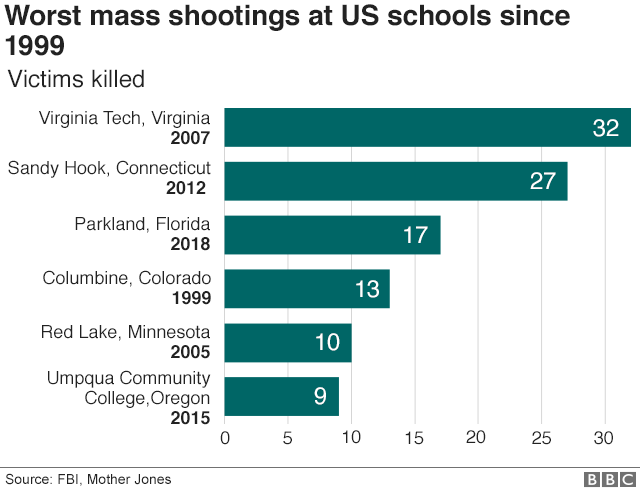
It is only February 14th, yet in 2018 there have been many school shootings already. The first occurred on January 10th in Sierra Vista, Arizona. On January 20th a 21-year-old was fatally shot at Wake Forest University in Winston-Salem, North Carolina during a fraternity event. A 14-year-old committed suicide in the school bathroom. On January 22nd in Italy, Texas, a 16-year-old shot and wounded a fellow classmate in the middle of the cafeteria. The same day another shooting occurred in New Orleans, Louisiana. A 14-year-old opened fire in the parking lot injuring a student. On January 23rd in Benton, Kentucky, a 15-year-old killed two students and injured 18 others. On February 1st in Los Angeles, California, a 12-year-old shot two students. In Oxon Hill, Maryland, on February 5th a student was shot in the parking lot. Today, February 14th, a gunman open fired in a high school in Parkland, Florida. It is reported that there were at least 14 victims, the death total is unclear. A suspect has been taken into custody, and has been identified as a former student. The government is aware of what is happening, and working with law enforcement as investigations are underway.  
The scary thing is that since 2013, there have been 290 school shootings in America alone.
What is being done for prevention?
This is a valid question, and one that has been trying to be answered for years.
The most current thing that has been done in January was the United States Army developing a first-person video game. This game is intended to be used to help teach the user how to react if they ever encounter an active shooter. This game will help teachers to be able to know what the best practices are if they are ever in a shooting situation. It can teach cops how to handle a shooter, as well as other security.  

Saturday, January 27, 2018

Hope for the Best, but Plan for the Worst

Natural disasters are going on all around us, even if we are oblivious to them.
How many of us knew that Paris is flooding, that California had deadly mudslides, or that Albay in the Philippines is getting ready for a possible three-month emergency!
The river Seine is rising in Paris. It has forced over 650 people to evacuate their homes, so they can be safe. The end isn’t even in sight.
Back in 1910 there was a time that a lot of Paris was under water for a couple months! Water levels are predicted to reach 6 meters, or 20 feet, above what is normal. As of this morning it was already 5.7 meters above the normal levels. As seen in the picture below. 
California is Sliding!
Weeks ago deadly mudslides occurred in the Santa Barbara area. It is believed that it was due to heavy rainfall and the recent fires as depicted in this image.
An evacuation was given displacing many families for the second time in the past couple months. The pictures below show the extensive damage done. However, no one can forget the 20 people were killed, and others are missing. Rescue missions were put into place that saved a lot of lives.


Legazpi City is Burning!
In the Philippines, Mount Mayon has erupted, spewing lava and ash all over Albay. 
Officials there are saying that they are getting ready for a three months emergency! more than 81,000 people have already evacuated. The rain that has fallen has done more harm than good. The picture below depicts how the rivers are now running with volcanic debris.
The threat level this volcano has caused is a threat level of 4, and that is on a five-point scale. 
Some experts believe that the worse is yet to come. Because of the bulging sides, it is believed that a powerful eruption is yet to come.  

Natural disasters are nothing new. One thing we can count on from life is that it is unpredictable. The best way to help reign in the chaos of life is to be prepared and come together. Many lives are saved through evacuations, and many are rescued when we band together. FEMA, Federal Emergency Management Agency, has said that “disasters are not avoidable”, “but you can be ready for them”. We should “hope for the best, but plan for the worst”. 

Wednesday, July 1, 2015

7 Reasons to be Grateful for Hurricanes


Image of a rainbow at the beach after a storm
You may have heard the phrase "you have to be cruel to be kind" before, but probably not in relation to hurricanes. What most people don't know is that despite being capable of massive destruction, they actually provide necessary services to our planet. We fall into the common trap of focusing on the bad things, but not the good. In reality, hurricanes are one of nature's greatest gardener! Here are 7 specific things that we should be grateful to hurricanes for. . .


A person's hands catching rainfall
  1. Rainfall can be very needed some years, and obviously a hurricane is a great way to put lots of water into the ground. Granted the flooding causes an incredible amount of damage, but keep reading and you'll see even more benefits.
  2. Hurricanes can maintain islands by dumping large amounts of sand on the beaches, restoring lost dirt due to erosion. Keeping islands in tact is important because there are "barrier" islands such as Long Island in New York that can help shelter the inland from storms and lessen the effects of them.
  3. With strong winds, hurricanes can balance the world's temperature by sharing tropical heat with the rest of the world. It blows hot tropical air from the equator north, keeping the equator a little cooler and us a lot warmer.
  4. They also cycle nutrients from the seafloor to the surface, revitalizing and renewing wild life in the ocean.
    Underwater image of the ocean
  5. Hurricanes give genetic diversity to many ecosystems because they help spread and plant seeds. Scientists speculate that many tropical plants in Florida came from seeds farther south in the tropics.
  6. Yet another benefit is that hurricanes add variety to nature through a process called ecological succession. Through this process both large and small plants go through cycles, maintaining the variety of plants. When large trees are blown over, the smaller plants and bushes start to flourish in the new sunlight. However, the trees will eventually come back. Because of this process, the smaller plants don't completely die off, and neither do the trees.
  7. Flush saltwater from hypersaline lagoons, which benefits life there. Hurricanes can make a hypersaline body of water have less chloride and sodium, making them much more livable.
So next time you suffer through a hurricane or even if you just watch the aftermath on T.V. you can feel a little better. Not that the destruction is a good thing, but there is hope in the idea that in the midst of destruction there is cleansing and rejuvenation.